Speed limits with a trailer – how fast can you drive?
The speed limit rules for trailers with and without brakes.
Many people assume the posted speed limit always applies, even when towing a trailer. That is not the case. The speed limit with a trailer is governed by its own rules, tied to whether the trailer has brakes and whether it is approved for higher speeds. If this comes up on the theory test, the key is to remember three numbers: 60, 80 and 100 km/h.
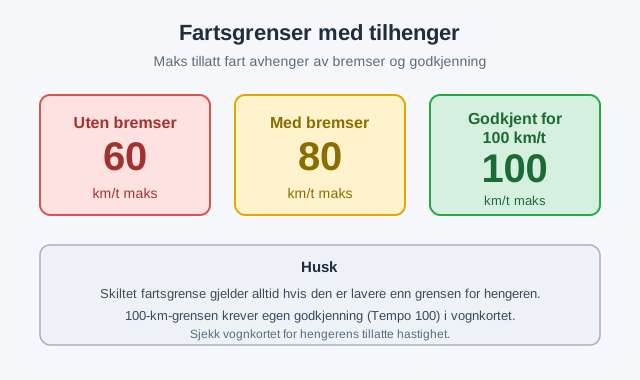
Table of contents
- The main rule for speed with a trailer
- Trailer without brakes – 60 km/h
- Trailer with brakes – 80 km/h
- Tempo 100 – when you can drive 100 km/h
- The posted limit always takes priority
- Frequently asked questions
The main rule for speed with a trailer
When you tow a trailer, the legal speed is the lower of two numbers: the posted speed limit on the road, and the maximum speed that applies to the car-and-trailer combination. You must never drive faster than the lower of these. Which number applies to the trailer depends first and foremost on whether it has its own service brakes.
The rules are easy to remember when you break them down:
| Type of trailer | Max speed (no posted restriction) |
|---|---|
| Without brakes | 60 km/h |
| With brakes | 80 km/h |
| Approved for Tempo 100 | 100 km/h |
These figures apply regardless of whether you drive a passenger car, and assume that weight and licence are in order. You will find the weight rules in the article on trailer weight and the licence and on the registration document and coupling load .
Trailer without brakes – 60 km/h
A trailer without brakes may be driven at a maximum of 60 km/h. This applies even on a motorway where the posted limit is much higher. Many small luggage trailers and simple cargo trailers have no brakes, so this is a rule that is easy to get wrong.
The reason for the low limit is the braking distance. Without its own brakes, the car alone must stop the entire weight of both the car and the load, which lengthens the stopping distance considerably. Read more about how distance and speed are linked in the article on the three-second rule .
Trailer with brakes – 80 km/h
If the trailer has its own brakes, you may normally drive up to 80 km/h, as long as the posted limit allows it. Most larger trailers, caravans and car transporters have an overrun brake that engages when the car brakes.
Remember, however:
- Check the registration document of the trailer for the speed it is approved for.
- Load it correctly – the right nose weight and load distribution keep the trailer stable. See load distribution and nose weight .
- Reduce speed in a tailwind, downhill and when swaying starts. Learn more about trailer sway and how to handle it .
Tempo 100 – when you can drive 100 km/h
Some trailers can be approved for 100 km/h through the scheme often called Tempo 100. Both the trailer and the towing car must then meet specific technical requirements, and the approval must be registered. If the combination is not approved, the 80 km/h limit still applies even where the road has a higher speed limit.
This is particularly relevant for modern caravans. The requirements for stability and tyres are stricter at high speed – see the article on caravans, stability and rules for details.
The posted limit always takes priority
Even if your trailer is approved for 80 or 100 km/h, you must never drive faster than the posted speed limit. If the limit is 50 km/h, then 50 km/h applies – no matter what the trailer can handle. It is worth revisiting the general speed limits and what an end-of-speed-limit sign means.
In short:
- Without brakes: max 60 km/h
- With brakes: max 80 km/h
- Tempo 100 approved: max 100 km/h
- Posted limit is lower? Then the posted limit applies.
Frequently asked questions
Does 80 km/h apply automatically because I have a large trailer? No. The trailer must have its own brakes. A heavy, unbraked trailer is still limited to 60 km/h.
What if I do not know whether the trailer has brakes? Check the registration document and look for a braking mechanism on the drawbar. If in doubt, stay at 60 km/h.
Want to check that you have a handle on the speed rules and the rest of the syllabus? Take a free theory test and practise in the Eteo app until you are ready for the theory test. Also learn the basic trailer requirements for class B and the difference between code 96 and class BE .
Next step
Continue with free car questions
Go straight from the article to free car questions and check what actually sticks before you keep reading more theory.
Try for free