Towbar and trailer lights – requirements and checks
Requirements for the towbar, electrical connector and checking trailer lights.
A safe towbar and trailer lights setup is what links the car and trailer together – both mechanically and electrically. The ball coupling keeps the trailer attached, while the electrical connector ensures the brake lights, indicators and rear lights on the trailer work exactly like on the car. As the driver you are responsible for making sure both are in order every time you set off, and this is a topic that often appears on the class B theory test.
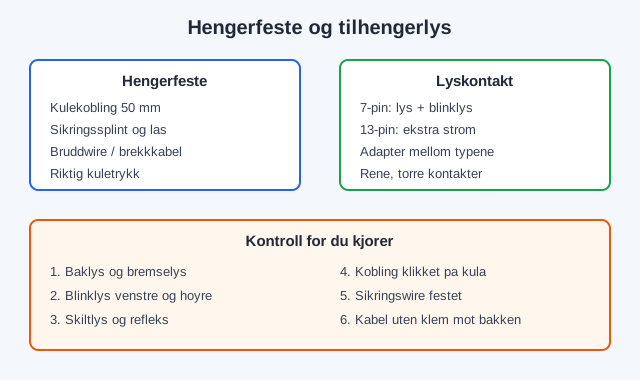
Table of contents
- Towbar and ball coupling
- Electrical connector: 7-pin and 13-pin
- Requirements for trailer lights
- How to check that everything works
- Common faults and fixes
Towbar and ball coupling
The most common towbar on passenger cars is a ball coupling with a ball of 50 mm in diameter. The trailer’s coupling head slides down over the ball and locks in place, so the trailer hangs securely on the car without being able to lift off while driving. In addition there should be a safety cable (breakaway cable) that brakes or stops the trailer if the coupling should come loose against all odds.
The towbar and ball must be approved and in good condition. Worn or cracked parts weaken the coupling, and a ball that is too worn can give unnecessary play. How much weight the towbar is rated for is linked to the car’s permitted trailer weight. Read more about how weights and coupling loads are read in car and trailer in the registration document and about the basic trailer requirements for class B .
The correct noseweight – that is, how hard the trailer presses down on the ball – is important for stable driving. Too little or too much pressure can give poor road grip and swaying.
Electrical connector: 7-pin and 13-pin
The lights on the trailer get power through an electrical connector between the car and trailer. There are two standard sizes:
| Connector type | Number of pins | Typical use |
|---|---|---|
| 7-pin | 7 | Ordinary trailers: lights, indicators, brakes |
| 13-pin | 13 | Caravans and trailers with extra equipment |
The 7-pin connector covers all the required light functions. The 13-pin also has conductors for continuous power, fridge and battery charging – useful on a caravan. If the car has 13-pin and the trailer 7-pin (or the other way around), you use an adapter between them.
The connectors must be clean and dry. Corrosion or dirt in the pins is a common reason why lights “flash wrong” or drop out. A thin layer of contact spray helps against moisture and rust.
Requirements for trailer lights
The trailer must show the same signals to the rear as the car. That means the following trailer lights must work:
- Rear lights – on when the car’s lights are on
- Brake lights – on when you brake
- Indicators – left and right, in time with the car’s indicators
- Number plate light – lights up the registration plate
- Reflector – red triangle reflector at the rear of the trailer
The triangle reflector is a distinct marking for trailers and must always be in place. Lights and light signals in general are a topic of their own; see lights and light types for a broader overview. The technical requirements for vehicles and trailers are set out in the vehicle regulations .
How to check that everything works
Do a quick check every time before you set off:
- Connect the plug and check that it sits firmly.
- Turn on the rear lights – check that the trailer lights up.
- Press the brake (or ask someone for help) – check the brake lights.
- Turn on the left and right indicators – check that both sides flash.
- Look that the number plate light lights up the plate.
- Check that the coupling has clicked onto the ball and that the safety cable is attached.
- Make sure the light cable does not hang so low that it gets pinched or dragged along the ground.
When you connect, the head clicks into place over the ball so the handle locks. The whole procedure is described step by step in how to connect a trailer to the car .
Common faults and fixes
| Symptom | Common cause | Fix |
|---|---|---|
| Indicators flash fast | Bulb out or poor contact | Replace bulb, clean connector |
| No lights at all | Fuse or loose connector | Check fuse, reconnect |
| Brake lights do not work | Break in conductor or switch | Check cable and connector pins |
| Swaying at speed | Wrong noseweight or load distribution | Adjust load and noseweight |
Swaying is often caused by how the load is placed. This is closely linked to load distribution and noseweight , and if the trailer starts to sway, it is useful to know the causes and measures for trailer sway . Once the coupling and lights are in order, the rest comes down to calm and anticipatory driving with a trailer .
Want to practise questions about trailers, lights and checks before the theory test? Take a free theory test and train in the Eteo app until you are confident and ready to pass.
Next step
Continue with free car questions
Go straight from the article to free car questions and check what actually sticks before you keep reading more theory.
Try for free