How to connect a trailer to your car – step by step
Step by step on how to connect a trailer, cable and lights correctly.
Knowing how to connect a trailer correctly is one of the most important things you do before driving out onto the road. A badly connected trailer can come loose, lose its lights or start to sway, which is both dangerous and illegal. In this guide we go through the whole process step by step, so you quickly become confident with the ball coupling, the breakaway cable, the light connector and the final check.
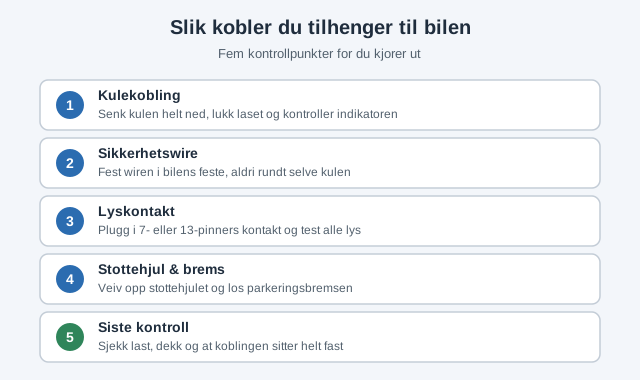
Table of contents
- Before you start
- Step 1: Position the car and reverse up
- Step 2: Couple the ball and lock
- Step 3: Breakaway cable and light connector
- Step 4: Jockey wheel, brake and final check
- Common mistakes
Before you start
Before you connect a trailer, you should check that your car is actually allowed to tow the trailer in question. With an ordinary class B licence you may tow a trailer with a permitted maximum weight of up to 750 kg, or a heavier trailer as long as the combined maximum weight of car and trailer does not exceed 3500 kg. Read more in trailer weight and class B licence and about the difference between code 96 and class BE .
Also make sure the coupling equipment matches. Most passenger cars in Norway use a standard 50 mm ball coupling, and the light connector is either a 7-pin or a 13-pin plug. If the car and trailer have different connector types, you will need an adapter.
| Equipment | What you check | Why it matters |
|---|---|---|
| Ball coupling | Correct diameter (usually 50 mm), clean and free of wear | The trailer can come loose if the ball is worn |
| Breakaway cable | Intact cable or chain with hook | Holds the trailer back if the coupling fails |
| Light connector | 7 or 13 pins, dry and clean | Faulty lights mean a fine and reduced safety |
| Jockey wheel | Working crank, undamaged wheel | Lets you adjust the height and park safely |
Step 1: Position the car and reverse up
Start by cranking the jockey wheel so that the trailer’s coupling cup sits slightly higher than the car’s tow ball. Then reverse the car slowly until the cup is right above the ball. Feel free to ask someone to guide you, and use your mirrors actively. Manoeuvring accurately in reverse is a skill you will also need later – see reversing with a trailer .
- Apply the parking brake on the car.
- Crank the jockey wheel so the cup is just above the ball.
- Reverse or push the trailer the last bit into place.
Step 2: Couple the ball and lock
Open the coupling handle on the trailer’s coupling cup. Then crank the jockey wheel downwards so the cup is lowered all the way onto the ball. When the cup is seated correctly, close the handle. Many couplings have an indicator that shows green or a visible marker when the coupling is correctly locked.
Always check that the coupling has engaged. The simplest test is to crank the jockey wheel down a little further: the rear of the car should then lift slightly together with the trailer. If the cup instead comes off the ball, you have not coupled correctly and must try again.
- Lower the cup all the way onto the ball.
- Close the handle and check the indicator.
- Lift test: the rear of the car should rise with it.
Step 3: Breakaway cable and light connector
The breakaway cable (or safety cable loop) is your backup if the coupling itself should come loose while driving. Attach the cable to a dedicated point on the tow bracket or thread it through the eye designed for it – never around the ball itself. The length should be such that the cable tightens and activates the trailer brake before the cup hits the ground, but not so tight that it lifts in corners.
Next, connect the light connector. Wipe away moisture and dirt, and plug the connector in firmly until it clicks. Then test all functions with a helper, or use the car’s own test function:
| Light function | How to test it |
|---|---|
| Tail lights/position lights | Switch on the lights and look for lights at the rear |
| Brake lights | Press the brake while someone watches from behind |
| Indicators | Turn on the indicators in both directions |
| Reversing and fog lights | Engage reverse and switch on the fog light |
If the lights do not work, the cause is usually a poor connection, corrosion or a faulty bulb. Properly working lights are a legal requirement – read more about what applies in requirements for trailers class B .
Step 4: Jockey wheel, brake and final check
Once the coupling and lights are in place, crank the jockey wheel all the way up and lock it into the transport position. A jockey wheel that hangs down can catch on the road surface or speed bumps. Then release the trailer’s parking brake if it has one.
Now do a final walk around the combination:
- The coupling is locked and the lift test has passed.
- The breakaway cable is attached to the car’s bracket, not around the ball.
- All lights and indicators work.
- The jockey wheel is fully up and locked.
- The load is secured and distributed correctly, with appropriate nose weight.
Correct load distribution and nose weight are crucial to keep the trailer from starting to sway. You will find more on this in securing cargo class B and in the general guide to driving with a trailer . Remember too that you usually have lower speed limits with a trailer, and that a good safety distance becomes even more important – see the three-second rule .
Common mistakes
Most mishaps when connecting a trailer are caused by rushing. These mistakes recur:
- The cup is not lowered all the way down before the handle is closed – the coupling looks locked, but is not secure.
- The breakaway cable is forgotten or attached around the ball instead of in the bracket.
- The light connector is not properly inserted, or the pins are corroded.
- The jockey wheel is left down and can catch on the road.
- The load is poorly distributed, so the nose weight is too low and the trailer sways.
If you take the time to go through the same steps every time, connecting a trailer quickly becomes a safe routine. Want to test how well you know the rules around trailers and driving? Practise with a free theory test and keep training in the Eteo app until you are ready for the theory test.
Next step
Continue with free car questions
Go straight from the article to free car questions and check what actually sticks before you keep reading more theory.
Try for free