Code 96 vs class BE – which one do you need?
The difference between code 96 and BE, weight limits and the requirements for each.
If you want to tow a heavier trailer or a caravan, you quickly move beyond what an ordinary class B licence covers. Then you have to choose between code 96 and class BE. The difference is mostly about the combined weight of car and trailer, and whether you need a practical driving test or just a course. Here is the overview you need to choose correctly.
Contents
- What does an ordinary class B cover?
- What is code 96?
- What is class BE?
- Comparison of weight limits
- How to choose correctly
What does an ordinary class B cover?
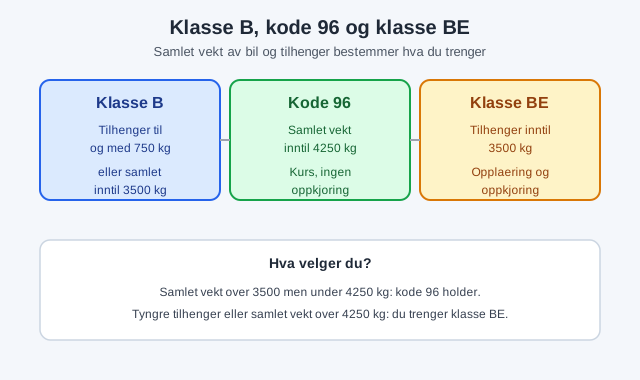
With an ordinary class B licence you may tow a trailer with a permitted maximum weight up to and including 750 kg, regardless of what the car weighs. You may also tow a heavier trailer, as long as the combined permitted maximum weight of car and trailer does not exceed 3500 kg. It is the sum of the vehicles’ weight limits that counts, not what they actually weigh on the day.
To know how much room you have, you need to understand the figures in the registration document. We explain them in the article on weight terms for passenger cars and how to read them in car and trailer – registration document and coupling load . When the sum exceeds 3500 kg, class B is no longer enough – and that is where code 96 and BE come in.
What is code 96?
Code 96 is an extension of class B, not a separate licence category. It is added as a numeric code after class B on your licence. With code 96 you may drive a car and trailer where the combined permitted maximum weight is up to 4250 kg. The trailer may therefore be heavier than ordinary class B allows, as long as the total stays below this limit.
The good thing about code 96 is that you do not need a practical test. The requirement is a mandatory course at a driving school, with both theory and practical training in coupling, loading and driving with a trailer. After completing the course, code 96 is added without a separate practical exam at the traffic station.
Code 96 suits you if you:
- Have a mid-sized caravan or a loaded trailer that takes you slightly over 3500 kg combined.
- Want to avoid the practical test and instead take a shorter, mandatory course.
- Do not need to tow the very heaviest trailers.
What is class BE?
Class BE is a separate licence category that gives the most room. With BE you may tow a trailer with a permitted maximum weight up to 3500 kg, in addition to a class B car. That gives a considerably higher combined weight than both class B and code 96, and it is what you need for heavy trailers, large caravans and loaded horse trailers.
For BE you must complete mandatory training and a practical driving test at the traffic station. There are also requirements for the rig you show up with, so that it actually tests your skills with a trailer of a certain size. Once passed, you keep the right for life, just like other categories in the overview of licence categories .
Comparison of weight limits
The table below shows the main differences. Remember that it is always the permitted maximum weight (the weight limits in the registration document), not the actual weight, that determines what is allowed.
| Class B | Code 96 | Class BE | |
|---|---|---|---|
| Trailer up to 750 kg | Yes | Yes | Yes |
| Heavier trailer | Combined up to 3500 kg | Combined up to 4250 kg | Trailer up to 3500 kg |
| Requirement | None added | Mandatory course | Training + practical test |
| Practical exam | No | No | Yes |
| Separate category | No | No (code on B) | Yes |
To check whether a specific trailer is within what you are allowed to tow, you must calculate the coupling load and what the car is approved to pull. We go into this in more detail in requirements for a class B trailer .
How to choose correctly
Start by adding up the permitted maximum weight of the car and the trailer you want to use:
- Is the sum up to and including 3500 kg? Then ordinary class B is enough.
- Is the sum between 3500 and 4250 kg? Then you need code 96.
- Do you want to tow a trailer heavier than this, or stay well above 4250 kg combined? Then you need class BE.
A common question concerns caravans. A light caravan can often be towed on class B or code 96, while a large one quickly requires BE. Driving technique and stability matter at least as much as the weight class, and we look closer at that in driving with a caravan – stability and rules . Remember too that separate speed limits with a trailer apply, and that correct coupling of the trailer to the car is crucial for safety.
Whatever you aim for – code 96 or BE – it is smart to have the traffic theory in place first. You can take a free theory test and keep practising in the Eteo app, so you are confident in the rules and ready for the theory test before you extend your licence.
Next step
Continue with free car questions
Go straight from the article to free car questions and check what actually sticks before you keep reading more theory.
Try for free