Load distribution and nose weight on a trailer
How to distribute the load and set the right nose weight on your trailer.
How you place the load decides whether the trailer follows calmly behind the car or starts to sway at speed. The key lies in two things: load distribution and nose weight. Get them right and the rig becomes stable, steering stays predictable and braking works well. Get them wrong and you risk snaking, poor grip on the car’s front wheels and, in the worst case, the trailer taking over the steering.
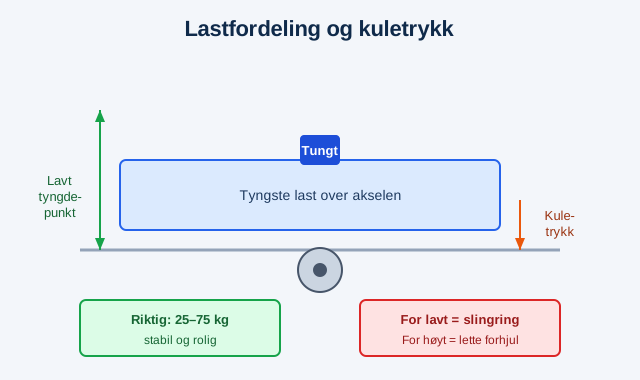
Table of contents
- What nose weight is and why it matters
- How to distribute the load correctly
- How to measure the nose weight
- Table: common mistakes and consequences
- Securing, weight and the law
What nose weight is
Nose weight is the vertical force the trailer’s drawbar presses down on the towball of the hitch. It is measured in kilos and listed as a maximum value in both the car’s registration document and on the trailer – you must stay within the lower of these two values. A suitable nose weight means part of the trailer’s weight rests on the car’s rear axle, which keeps the rig calm.
Too little nose weight makes the trailer “rear-heavy”. The drawbar goes light, and the smallest side force – a gust of wind, a passing truck or a sharp steering input – can trigger snaking that feeds on itself. Too much nose weight unloads the car’s front wheels, weakens steering and can overload the rear axle. On most passenger cars a sensible nose weight falls in the 25–75 kg range, but always check the specific values for your car and trailer.
How to distribute the load
The main rule is simple: the heaviest part of the load goes over or slightly in front of the trailer’s axle, not at the very back and not all the way forward. That keeps the centre of gravity low and central, and the nose weight naturally lands in the right zone.
- Place the heaviest item first, right over the axle, and arrange lighter things around it.
- Keep the centre of gravity as low as possible – do not stack tall and narrow.
- Spread the weight evenly side to side so the trailer does not lean.
- Lash everything down so the load cannot shift while driving and change the nose weight.
A load that slides backwards on a bumpy road can turn a stable trailer unstable in seconds. Read more about securing cargo in the article on securing cargo , and about why snaking happens in trailer snaking and remedies .
How to measure the nose weight
You do not need advanced equipment. The simplest method is a nose weight gauge placed under the drawbar, or an ordinary bathroom scale with a sturdy wooden stick at the right height so the drawbar sits level, roughly as it rests on the car’s towball. Measure when the trailer is fully loaded and ready to drive.
- Set the drawbar at the same height as the car’s towball.
- Read the weight directly under the coupling eye.
- If the weight is too low: move some load forward. Too high: move some load back.
- Measure again after each adjustment until you are within the recommended range.
Remember that both the car and the trailer have limits. Which weights your licence allows depends on the licence category – see trailer weight and class B licence and find the permitted values in registration document and coupling load .
Common mistakes and consequences
| Situation | What happens | Remedy |
|---|---|---|
| Load too far back | Low nose weight, snaking at speed | Move heaviest load forward to the axle |
| Load too far forward | Too high nose weight, light front wheels | Move load slightly back |
| High centre of gravity | Tips easily in bends and crosswind | Stack low and wide |
| Uneven side to side | Trailer leans, uneven tyre wear | Distribute weight symmetrically |
| Unsecured load | Shifts, changes nose weight suddenly | Lash down with straps |
Securing, weight and the law
A trailer must not only be loaded correctly – it must also be loaded legally. Overloading weakens brakes and tyres and is illegal. The consequences of too heavy a load are described in heavy load and consequences . Stability matters even more for tall, wind-catching trailers such as a caravan – read caravan driving and stability .
Driving with a trailer changes the rig noticeably; read more about handling it in driving with a trailer . Make sure the hitch is fitted correctly before you load – read coupling a trailer to the car .
Correct load distribution and nose weight are classic topics on the theory test. To practise questions on this and the rest of the syllabus, take a free theory test and keep training in the Eteo app until you are ready for the theory exam.
Next step
Continue with free car questions
Go straight from the article to free car questions and check what actually sticks before you keep reading more theory.
Try for free