Trailer Sway – Causes and How to Stop It
Why trailers start to sway and how to stop it.
Trailer sway is when the trailer starts to swing from side to side behind the car, often at high speed or after a gust of wind. The phenomenon can escalate quickly from small movements into an uncontrolled oscillation that pulls the whole rig off course. If you drive a class B car with a trailer, it is vital to understand why the sway happens – and what to actually do when it starts.
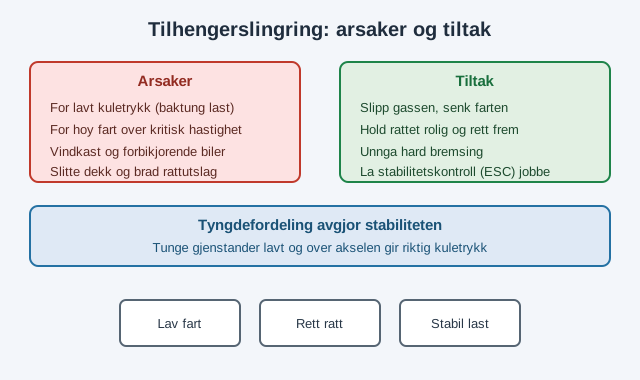
Table of contents
- What is trailer sway?
- Common causes
- Weight distribution and nose weight
- Speed and tyres
- How to stop the sway
- Prevention before you drive
What is trailer sway?
Sway occurs because a single-axle trailer can pivot around the coupling point on the tow ball. With a small disturbance – a gust of wind, an evasive manoeuvre or a bump in the road – the trailer gets a sideways deflection. If the forces meant to damp that deflection are too weak, the oscillation builds up with each swing instead of dying out. This is called self-amplifying sway, and it is the dangerous variant.
The higher the speed, the less damping the system has. Above a certain critical speed, each swing becomes stronger than the previous one, and you can lose control. That is why sway is almost always first felt at high speed on the motorway or on a downhill stretch.
Common causes
Most cases of sway can be traced back to a few basic mistakes:
- Too little weight on the ball – the load is placed too far back on the trailer.
- Excessive speed – above the critical speed for the rig.
- Wind gusts and overtaking trucks – sudden side forces set the oscillation going.
- Worn or wrong tyres – low pressure and poor grip reduce stability.
- Abrupt steering inputs – sudden evasive moves transfer motion to the trailer.
- High centre of gravity – caravans and boat trailers are especially exposed to crosswinds.
For a deeper look at how weight affects driving, see the article on heavy loads and their consequences .
Weight distribution and nose weight
The single factor that most often decides whether a trailer sways is weight distribution. Heavy items should be placed low and directly over or slightly ahead of the trailer’s axle. That gives a stable centre of gravity, and a suitable share of the weight rests on the ball as nose weight.
| Load placement | Effect on nose weight | Risk of sway |
|---|---|---|
| Heavy load far forward | Too high nose weight | Rear axle unloaded, poor steering |
| Heavy load over the axle | Correct nose weight | Low – most stable |
| Heavy load far back | Too low nose weight | High – trailer sways easily |
Too low a nose weight is the classic sway trap: the trailer becomes “tail-heavy”, and the slightest disturbance sets it oscillating. Always check the manufacturer’s recommended nose weight and the vehicle’s permitted ball load. You will find more on the link between weight and handling in the guide on driving with a trailer .
Speed and tyres
Speed is the most direct trigger. Since the critical speed drops when the load is misplaced, a good rule is to slow down the moment you feel any hint of swaying – and generally keep a good margin to the speed limit when towing.
Tyres also play a big role. Correct pressure and sufficient tread depth give the trailer the grip it needs to counter side forces. Low pressure makes the tyre wall soft, so the trailer “wanders” and oscillates more easily. This applies to both the car’s and the trailer’s tyres.
Side forces from weather and overtaking traffic amplify the problem. Read more about how air movement affects the vehicle in the article on crosswind and gusts .
How to stop the sway
Once the sway has started, the key is to not make it worse. Follow these steps:
- Ease off the accelerator and let the speed fall gradually. Lower speed increases damping.
- Hold the steering wheel calm and straight ahead. Do not try to “counter-steer” the oscillation – abrupt steering makes it worse.
- Avoid hard braking. Heavy braking can throw the trailer further off course.
- Brake gently and straight once the speed is already coming down, ideally with light pressure.
- If the car has electronic stability control with trailer stabilisation, let the system work and do not brake in panic.
Many newer cars have an anti-sway function as part of the stability system. It detects the oscillation and brakes the wheels in a targeted way. Understand how this works in the article on electronic stability control (ESC) .
Prevention before you drive
The best measure is to prevent sway from arising at all:
- Place heavy items low and over the axle, and secure the load so it cannot shift.
- Check the nose weight and that the trailer sits level.
- Check tyre pressure and tread depth on all tyres.
- Keep a moderate speed, especially on downhills and in wind.
- Be extra careful with tall, light trailers such as caravans – see caravan: driving, stability and rules .
Questions about stability and load are popular topics on the theory test. Want to test yourself before the exam? Take a free theory test and keep practising in the Eteo app until you are confident on everything from sway to right of way and ready for the theory test.
Next step
Continue with free car questions
Go straight from the article to free car questions and check what actually sticks before you keep reading more theory.
Try for free