Driving in blowing snow and poor visibility
How to handle visibility, lights and speed when blowing snow cuts your sight.
Driving in blowing snow is one of the most demanding situations you can meet in winter. The wind tears loose snow off the ground and throws it into the air, so visibility can drop from several hundred metres to almost nothing in seconds. At the same time the wind leaves drifting snow across the road, which both hides the lane markings and makes the surface slipperier. This article shows you how to read the conditions, use your lights correctly and keep a speed that lets you stop within the sight distance you actually have.
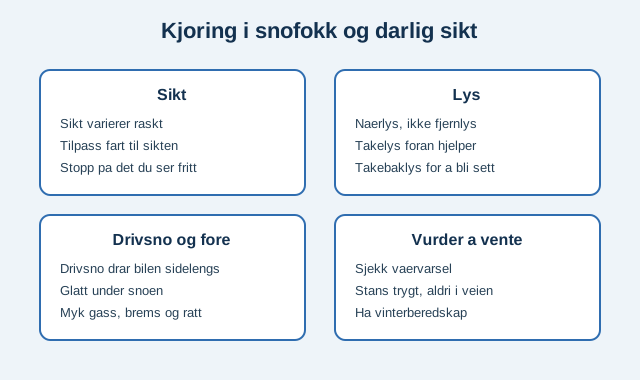
Table of contents
- What happens in blowing snow
- Visibility and speed are linked
- Correct use of lights
- Drifting snow and slippery roads
- When you should wait
What happens in blowing snow
Blowing snow occurs when loose, dry snow is whirled up by the wind. The stronger the wind and the looser the snow, the denser the drift becomes. You recognise the conditions by how quickly visibility changes: open stretches and bridge decks can sit in thick drift, while in the shelter of a forest or a mountainside you suddenly see clearly again. This alternation is dangerous because it tempts you to speed up in the clear sections.
An important point is that blowing snow does not require snowfall. It can be clear and sunny, yet strong wind still drags snow off the ground and builds drifts on the road. The conditions are closely related to those you meet in dense fog : sight is your most important sense, and when it fails, everything else must be adapted.
Visibility and speed are linked
The basic rule is simple: you must always be able to stop within the stretch of road you can see is clear ahead of you. It is not enough to see well enough to stay on the road - you must be able to come to a full stop before an obstacle you spot within the sight distance. In thick drift this can mean slowing to walking pace.
The table below gives a rough guide. Remember that a slippery surface lengthens braking distance sharply, so on winter roads you should stay at the lower end of each range.
| Visibility ahead | Indicative max speed | What you should do |
|---|---|---|
| Over 200 m | Near-normal winter speed | Keep good distance, be ready to brake |
| 100-200 m | Clearly reduced | Slow down, increase distance |
| 50-100 m | Low | Drive carefully, dipped beam and fog lights on |
| Under 50 m | Very low | Consider stopping safely and waiting |
Build in extra margin by keeping a generous following distance. Read why in the article on the three-second rule ; in blowing snow you should stretch this to four or five seconds.
Correct use of lights
Lights in blowing snow are about two things: seeing and being seen. The wrong light use can make visibility worse for yourself.
- Dipped beam, not main beam. Main beam reflects off the swirling snow crystals and creates a white wall in front of you. Always use dipped beam in thick drift.
- Front fog lights can help because they shine wide and low, beneath most of the drift.
- Rear fog lights make you clearly visible from behind in very poor visibility. Switch them off again as soon as visibility improves so you do not dazzle the car behind.
- The car must be clean. Clear snow off lamps, windows and roof before driving - see the separate guide on scraping and removing snow from the car .
You will find more on when to use the different lights in the article on use of lights and signals .
Drifting snow and slippery roads
The wind leaves tongues of drifting snow across the road, often in the lee behind plough banks, guard rails and terrain features. These drifts can appear suddenly, and when you hit them, rolling resistance increases abruptly on one side. This can pull the car sideways - the effect is a little like crosswind and gusts . So keep a firm but relaxed grip on the wheel and avoid sudden corrections.
Beneath the drifting snow there is often a slippery surface, and the lane markings are gone. Then you must orient yourself by plough banks, snow poles and the vehicle ahead. These conditions are closely tied to general driving under difficult conditions and call for smooth use of throttle, brake and steering. In the mountains convoy driving may also become relevant, where you follow a snowplough in a set order.
When you should wait
Sometimes the right choice is not to drive at all. Blowing snow varies a lot during the day, and it can be wise to postpone the trip until the wind eases or the road is ploughed.
- Check the forecast. Follow reports on weather and closed mountain passes before you set off.
- Be realistic about your fitness to drive. Stress and tiredness weaken judgement - read about stress and time pressure and about fatigue and microsleep .
- Stop safely if visibility disappears. Find a rest area or petrol station. Never stop in the carriageway in thick drift; you risk being hit from behind.
- Have winter preparedness. Warm clothes, food, drink and a fully charged phone give security if you have to wait a long time.
A solid grasp of these conditions is part of the syllabus for the class B theory test. If you want to test yourself, you can take a free theory test and keep practising in the Eteo app until you are confident and ready for the theory test.
Next step
Continue with free car questions
Go straight from the article to free car questions and check what actually sticks before you keep reading more theory.
Try for free