Road salt and winter maintenance – effect on driving and your car
How salting, plowing and grit affect driving and grip.
In winter, the roads authority and municipalities work constantly to keep roads passable. Road salt and winter maintenance such as salting, plowing, grading and gritting constantly change the surface you drive on. As a class B driver you need to understand how these measures affect grip – and why a salted road is not always as safe as it looks. Here is the overview you need.
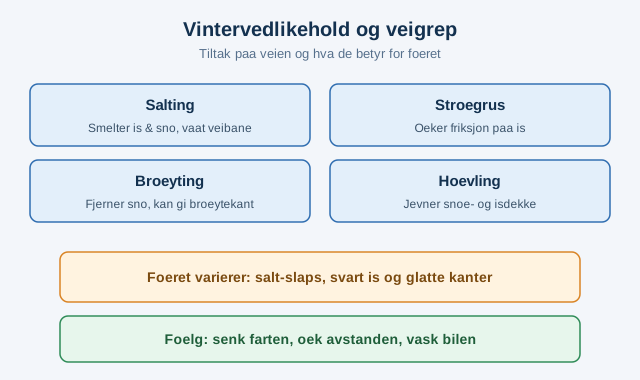
Table of contents
- Why roads are salted and gritted
- How the measures affect grip
- Salt slush, black ice and snow banks
- What road salt does to your car
- How to adapt your driving
Why roads are salted and gritted
Winter maintenance has one main goal: to keep traffic moving and reduce accidents. On heavily trafficked roads, salting is often used because salt lowers the freezing point of water and melts ice and snow. On smaller roads, cycle and pedestrian paths, and where temperatures are very low, grit (sand or gravel) is used instead, providing mechanical friction without melting the ice.
In addition there is mechanical maintenance:
- Plowing removes snow from the carriageway.
- Grading evens out hard-packed snow and ice.
- Gritting lays gravel in the wheel tracks for better grip.
The different methods are combined according to temperature, precipitation and road type. As a result, conditions can change quickly from one stretch to the next.
How the measures affect grip
A common misconception is that bare, wet asphalt always means good grip. When a road has just been salted, a mix of meltwater and salt often lies on the surface. This can give almost as little grip as pure ice, because the water film reduces contact between tyre and road.
| Measure | Effect on conditions | What you should do |
|---|---|---|
| Salting | Melts ice, but leaves wet, slippery slush | Slow down, increase distance |
| Grit | Better grip on ice, but gravel can spray | Keep a good distance to the car ahead |
| Plowing | Bare road, but snow banks alongside | Watch for snow walls and narrow lanes |
| Grading | Smoother, but hard-packed and slick | Treat it as slippery icy conditions |
Remember that salt stops working when it gets very cold, often below around minus 6 to minus 10 degrees Celsius. A road that has just been salted can then refreeze and become extra slippery. You can read more about the surface in the article on road grip and friction .
Salt slush, black ice and snow banks
Winter maintenance creates some typical hazards you must recognise:
- Salt slush collects in the wheel tracks and sprays onto the windscreen. Good washer fluid and working wipers are essential.
- Black ice forms when meltwater refreezes overnight. It is almost invisible – read more about spotting it in the guide on black ice .
- Snow banks narrow the road and can hide pedestrians and kerbs.
- Grit can remain in bends and create a loose surface, especially in spring.
When conditions switch between bare road and patches of ice, you are especially exposed. Practical techniques for such conditions are found in the article on driving on slippery roads and in the guide on starting and driving on ice .
What road salt does to your car
Salt is effective against ice but hard on your car. Salt water increases the risk of rust and corrosion, especially on the underbody, brake lines and suspension. Salt and grit also wear on the paint and can clog drainage holes.
To limit the damage you should:
- Wash the car regularly through the winter, and rinse the underbody well.
- Keep the windscreen clean so visibility is not impaired by salt slush.
- Check that drains and door seals are free of grit.
The right tyre choice also matters greatly for how the car handles salted and slippery roads. Compare the options in the guide on studded versus non-studded winter tyres and consider when you should switch to winter tyres .
How to adapt your driving
No matter how well the road is maintained, you as the driver are responsible for driving according to conditions. That usually means:
- Slow down when conditions are uncertain, even if the road looks bare.
- Greatly increase your safety distance on salt slush and ice.
- Brake and steer gently to avoid losing grip.
- Be extra careful on bridges, in shade and at night, where black ice forms most easily.
These judgements are a central part of the class B theory. Want to test yourself? Take a free theory test and keep practising in the Eteo app to be well prepared for the theory exam.
Next step
Continue with free car questions
Go straight from the article to free car questions and check what actually sticks before you keep reading more theory.
Try for free