Calling 113 and alerting the emergency services correctly
What to say to 113, and how to give a precise location quickly.
If you are the first to arrive at a traffic accident, you become the link between the scene and the help on its way. Calling 113 and alerting the emergency services correctly is one of the most important tasks you have as a driver, and something you must know for the class B theory test. A calm, precise emergency call gives medical staff and rescue crews the information they need to send the right help to the right place. In this article you will learn which emergency numbers apply, what to actually say, and how to report your location when you do not know where you are.
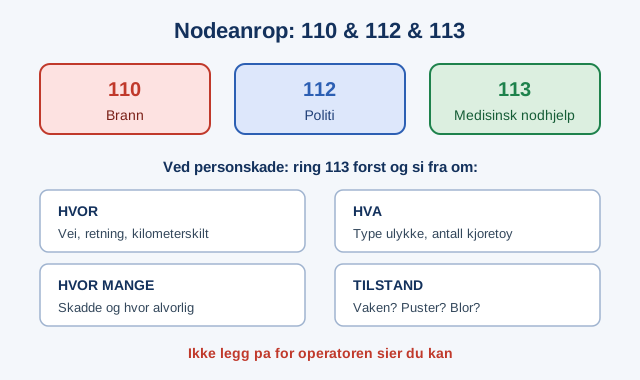
Table of contents
- The three emergency numbers
- How to prioritise at the scene
- What to say when you call 113
- How to give a precise location
- Common mistakes during an emergency call
The three emergency numbers
Norway has three short emergency numbers that are free to call from any phone, including from a mobile without your own subscription coverage and without a SIM card for medical emergencies. You should know them by heart.
| Number | Service | When to call |
|---|---|---|
| 110 | Fire | Fire, smoke, fuel leaks or hazardous goods |
| 112 | Police | Traffic accident, danger to life, crime |
| 113 | Medical emergency (AMK) | Personal injury, unconsciousness, breathing arrest, severe bleeding |
In a traffic accident with personal injury, you call 113 first. The AMK centre can coordinate with both the police and the fire service, so you usually do not need to call all three. If there is only material damage and no one is injured, it is not an emergency call – instead you contact your insurer and, if needed, the police on the ordinary number 02800.
How to prioritise at the scene
Before you pick up the phone, the scene must be safe. The order you work in is often called secure, alert and help, and runs through the whole training:
- Secure the scene: stop, switch on the hazard lights, put on a reflective vest and place a warning triangle so that you are not hit yourself.
- Alert the emergency services by calling 113.
- Help the injured with first aid until help arrives.
Read more about protecting the scene in the article on securing the accident site and about the overall order in first aid at a traffic accident . As a driver you also have a legal duty to help and to report, explained in duties after a road accident .
What to say when you call 113
The operator at the AMK centre controls the conversation and asks you questions in a set order. Your job is to answer calmly and precisely – do not hang up until the operator says you can. Be ready to give:
- Where it happened: road, direction of travel, nearest place, kilometre marker or known landmarks.
- What happened: type of accident, number of vehicles, whether anyone is trapped.
- How many are injured, and how serious.
- The condition of the injured: are they awake, are they breathing, are they bleeding heavily?
- Who you are and which phone number you are calling from.
The operator can guide you through life-saving first aid while you wait, for example cardiopulmonary resuscitation or placing an unconscious person who is breathing in the recovery position. Follow the instructions exactly and keep the phone available on speaker if you need both hands.
How to give a precise location
The most common delay in an emergency call is that the caller does not know where they are. A precise location is often the difference of minutes, and minutes count. Use these sources in order of priority:
| Source of location | What you give |
|---|---|
| The map app on your phone | Coordinates or the address shown in the app |
| Road signs | Road number (E6, Rv4) and the nearest kilometre marker |
| Place names | Village, junction, bridge, tunnel or petrol station nearby |
| Let 113 help | The emergency centre can often trace an approximate position from the mobile |
Many newer cars can also alert automatically. The eCall system calls 112 and sends the position after a heavy collision, which you can read more about in the article on eCall and SOS functions . Even if the car alerts, you should be ready to confirm the details verbally.
Common mistakes during an emergency call
Even experienced drivers make mistakes under pressure. Stress and time pressure can make it hard to think clearly, as we describe in the article on stress and time pressure in traffic . Avoid these mistakes:
- Calling the wrong number and wasting time – with personal injury you call 113.
- Hanging up too early before the operator has all the details.
- Giving an imprecise location such as “somewhere on the E6”.
- Walking into dangerous situations without securing the scene first.
- Not keeping the line open for first-aid guidance.
Remember that as a driver you have an independent duty to help and to alert in an accident. If you want to refresh the whole licensing process, you can read about how to get your class B licence .
Knowledge of emergency calls is a typical part of the theory test. Test yourself with a free theory test and keep practising in the Eteo app, so that you are confident and well prepared for the class B theory test.
Next step
Continue with free car theory questions
Go straight from the article to free car theory questions and check what actually sticks before you keep reading more theory.
Try for free